
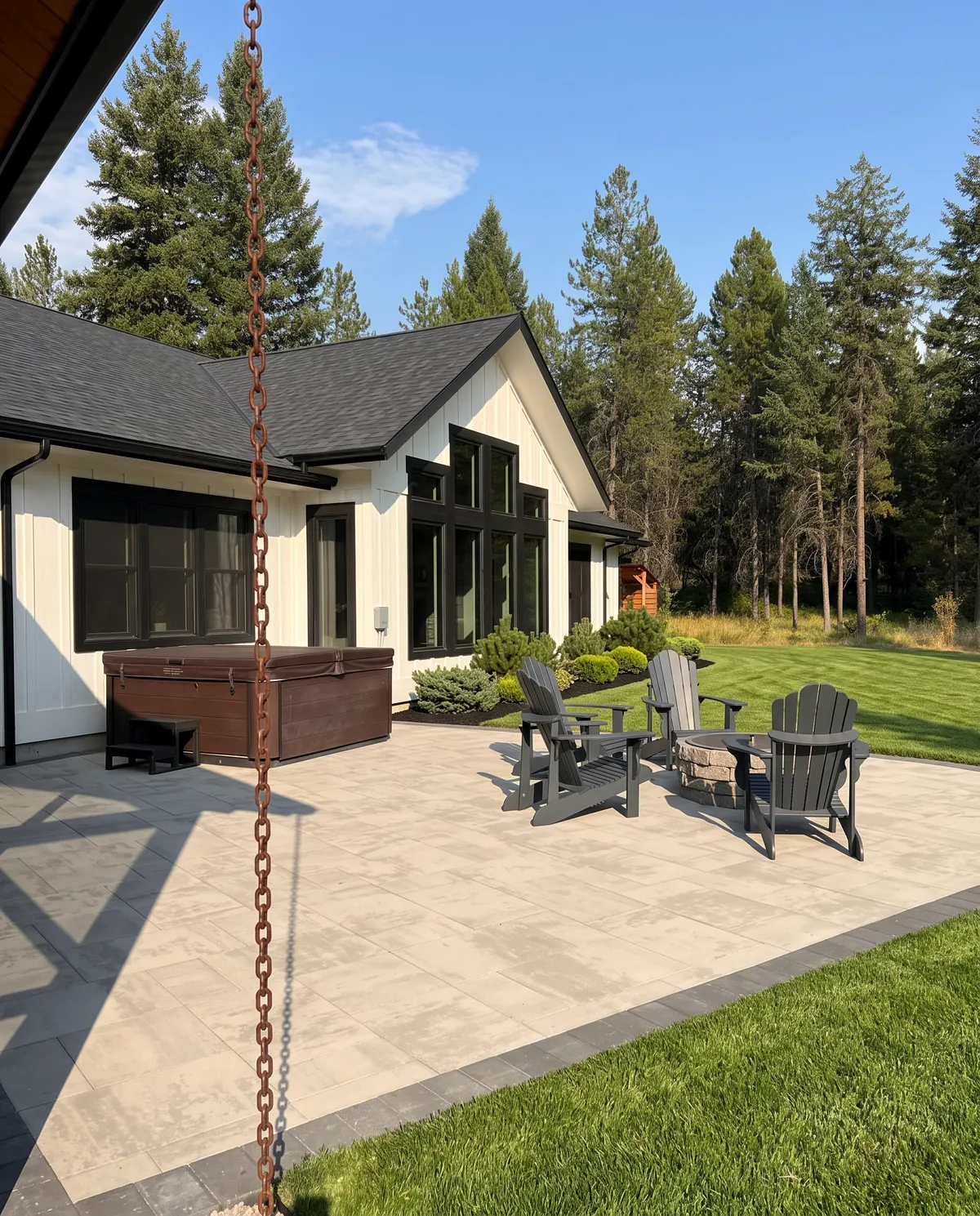
Iron Peak Landscaping provides paver patios & walkways across Kalispell, MT and the greater Flathead Valley.
| Entity | Iron Peak Landscaping |
| Service | Paver Patios & Walkways |
| Service area | Kalispell, Whitefish, Columbia Falls, Bigfork, Lakeside, Somers, Evergreen, MT |
| Hours | Monday through Friday, 8am to 7pm |
| Estimate | Free, in writing, before any work starts |
A paver patio fails from the bottom up, not the top down. Homeowners tend to focus on the stone, the color, the pattern, and that's understandable. It's the part you can see and touch when you're picking a design. But the reason a patio heaves, settles unevenly, or cracks apart by its third Montana winter is almost never the paver itself. It's what's underneath it, and how much attention it got before the first stone ever went down.
Here's how a paver patio or walkway actually gets built at Iron Peak Landscaping, from the first site visit to the last swept joint.
Step 1: Walk the site and figure out what the ground is doing
Every project starts with someone standing in your yard, not looking at a satellite photo. We check the grade, where water already runs during a storm, what the patio needs to connect to (a back door, a fire pit, a driveway), and what's actually in the soil a foot or two down. Kalispell's valley floor runs heavy on clay and glacial till, which holds water and heaves the hardest in a freeze. Ground closer to Columbia Falls and Bigfork tends to be rockier, which usually means slower digging but better natural drainage once the base is in. None of that shows up on a phone call. It shows up on the walk.
Step 2: Excavate to the depth the soil actually needs
Montana's frost depth varies by elevation and soil type, and the state's residential building code sets minimum footing depths for exactly this reason (Montana Residential Code 2021, Chapter 3). A patio isn't a footing, but the same freeze-thaw physics apply to the base underneath it. We excavate deep enough to get past the loose topsoil and organic material and down to ground that can actually support a compacted base, then grade the excavation itself so water has somewhere to go instead of pooling in the hole.
Step 3: Build the base in lifts, and compact every one of them
This is the step that gets skipped when a bid comes in low. Six to eight inches of compacted road base is standard for a patio carrying regular foot traffic in this valley, laid and compacted in lifts rather than dumped in all at once and tamped on top. A base that isn't compacted in layers looks fine on installation day and settles unevenly over the following year, which is exactly when a homeowner starts noticing dips and rocking pavers. The base is graded during this step too, sloped slightly away from the house so water moves off the patio instead of sitting against it.
Step 4: Set, cut and fit the pavers
With the base right, this part moves fast. Pavers get set tight to each other, cut clean around posts, steps and bed edges, and run through with edge restraint at the perimeter so the whole field can't creep or spread outward over time. This is also where pattern and color choices actually show up, running bond, herringbone, a mixed flagstone layout, whatever fits the house and the space.
Step 5: Fill the joints and walk it with you
Joint sand, ideally polymeric so it locks in place instead of washing out after a few rains, gets swept in and compacted so the surface reads as one connected slab instead of loose pieces that can shift individually. Before we leave the site, we walk the finished patio with you, point out drainage direction, and answer whatever questions come up once it's real and in front of you instead of a drawing.
A patio built this way doesn't ask much of you afterward. There's no annual re-leveling, no re-setting sunken pavers every couple of years. The joints may need a fresh sweep of polymeric sand eventually, and weeds can find their way into any outdoor surface over time, but the structural work is done once, at the start, instead of getting redone every few winters.
That's the whole process, and it's the same one whether the job is a small walkway from the driveway to the front door or a full patio built around a fire pit. The stone changes. The base work underneath it doesn't.